
- wet basement why
- crack in basement wall getting bigger
- is a bowing basement wall dangerous
- water in basement after heavy rain
- floor sloping upstairs old house
- musty smell in crawl space
That’s a sample of what homeowners around you are typing into Google right now — usually late at night, usually right after finding water on the floor or noticing that the crack they’d been ignoring got wider. Read the list again and notice what’s missing. There’s not a single company name on it. Not yours. Not the franchise’s. Nobody’s.
Homeowners search their symptom. Most contractor websites are organized around the company. That gap, between what she typed and what your site says, is where ad budgets die. Closing it is what this post is about, and the tool for closing it is what marketers call a landing page. Strip the jargon and a landing page is just this: a page built for one visitor with one problem, the page your ad click lands on. Landing pages for contractors aren’t a design upgrade. They’re a matching exercise.
Nobody is searching for you
Sit with that list of searches for a minute, because it tells you three things about the person typing.
She doesn’t know your industry’s words. She’s not searching “hydrostatic pressure relief” or “carbon fiber wall reinforcement”. She’s searching “wall bulging inward” because that’s what she can see. Symptom language, not solution language.
She’s nervous. A foundation problem isn’t a leaky faucet; in her head it’s “is my house okay” money. Nervous people don’t browse. They scan for the first sign that someone understands their exact situation.
And she has zero loyalty at this stage. You haven’t earned any yet. Neither has anyone else. The company whose page speaks her language first is the company that gets the inspection request; the reputation you’ve spent twenty years building doesn’t count in a search she’s making for the first time.
Homeowners type their symptom, not your company name. The page that wins is the page that says their words back to them in the first three seconds.
Where the click lands is where the money leaks
Follow one click all the way through. A homeowner searches “bowing basement wall,” your ad shows up, she taps it. If you’re like most contractors we audit, that click lands on your homepage:
Foundation Repair. Basement Waterproofing. Crawl Space Encapsulation. Concrete Lifting. Sump Pumps. Egress Windows. Drainage Systems. Nine services in the navigation, a rotating banner up top, the phone number buried three menus deep, and nowhere on the entire page a button that tells her what to do next.
None of it is wrong, exactly. It’s just answering a question she didn’t ask. She searched about her wall and the page is talking about your company. So she does what everyone does with a page that doesn’t match: gives it a few seconds, hits back, taps the next result. She’ll never find out you’re the best structural crew in the county. The page never got that far.
Here’s the part that stings. You paid for that click. In competitive local trades, clicks aren’t cheap; we walked through real click costs in our Google Ads budget guide, and they’re higher than most owners guess before they look. A homepage that shrugs at visitors doesn’t just cost you a lead. It costs you a lead you already bought.
There’s a second reason this matters, and it’s structural. When your ads point at your own pages, every lead that comes in is yours alone. Nobody resold it, nobody’s racing you to the callback. That’s the machinery behind results like 61 leads in a single month, every one exclusive, and each costing roughly three-quarters of what the shared platforms had been charging. That was a roofing client, not foundation repair, but the plumbing is identical: ads under the contractor’s own name, landing on pages only they control.
Build one page per problem
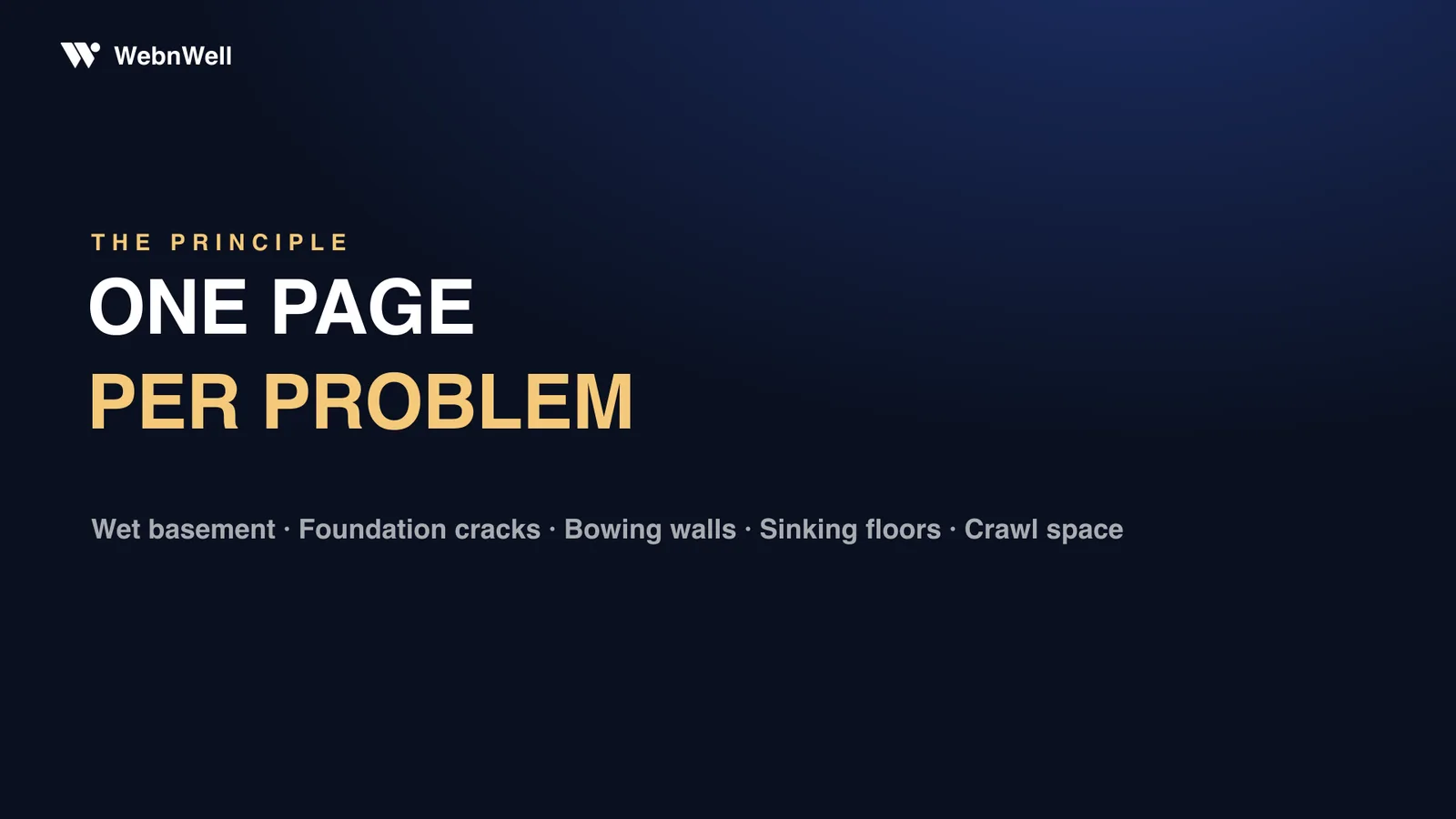
The fix isn’t a prettier homepage. It’s more pages, one for each problem a homeowner might arrive with:
- Wet basement / water after rain
- Foundation cracks (walls and floors)
- Bowing or buckling walls
- Sinking or uneven floors
- Crawl space moisture, if you do that work
Five pages, give or take, depending on your services. Each one exists for exactly one visitor: the person who typed that symptom. Your wet-basement ad points at the wet-basement page. Your bowing-wall ad points at the bowing-wall page. Nobody gets dumped on the homepage and asked to find their own way.
This isn’t about making the website bigger for its own sake. Each page has one job, and you can measure whether it does it: how many of the people who land there ask for an inspection. A homepage serving eight audiences can’t be measured that way, because it isn’t really for anyone.
What goes on the page? Three things.
You can find fifty-item landing-page checklists online. Ignore them. Every problem page that books inspections comes down to three parts.
A headline that names the symptom
The first words on the page should be her words. “Water in your basement after it rains?”, not “Complete Foundation & Waterproofing Solutions.” She should feel, instantly, that she’s in the right place. Your company name can sit in the corner where it belongs; the headline belongs to her problem.
Proof that calms a scary purchase
This is a five-figure decision about the thing holding her house up, so the page has to do the reassurance work a salesperson would normally do. Photos of that exact repair, on houses like hers. Not stock photos of hard hats. Reviews that mention that problem by name. Your warranty in plain English, not fine print. Faces of the crew who’d show up at her door. Trust is the product here; the repair is almost secondary.
One action, not eight links
The whole page funnels to a single next step: book the inspection. One form or one number, at the top and again at the bottom. Not a services dropdown, not a “learn more” maze, not your company history. Someone scared about her wall at 11pm doesn’t want options. She wants to know what to tap.
And when she does tap it, answer fast. A form submission that sits until tomorrow afternoon is a lead you handed to whoever called back first.
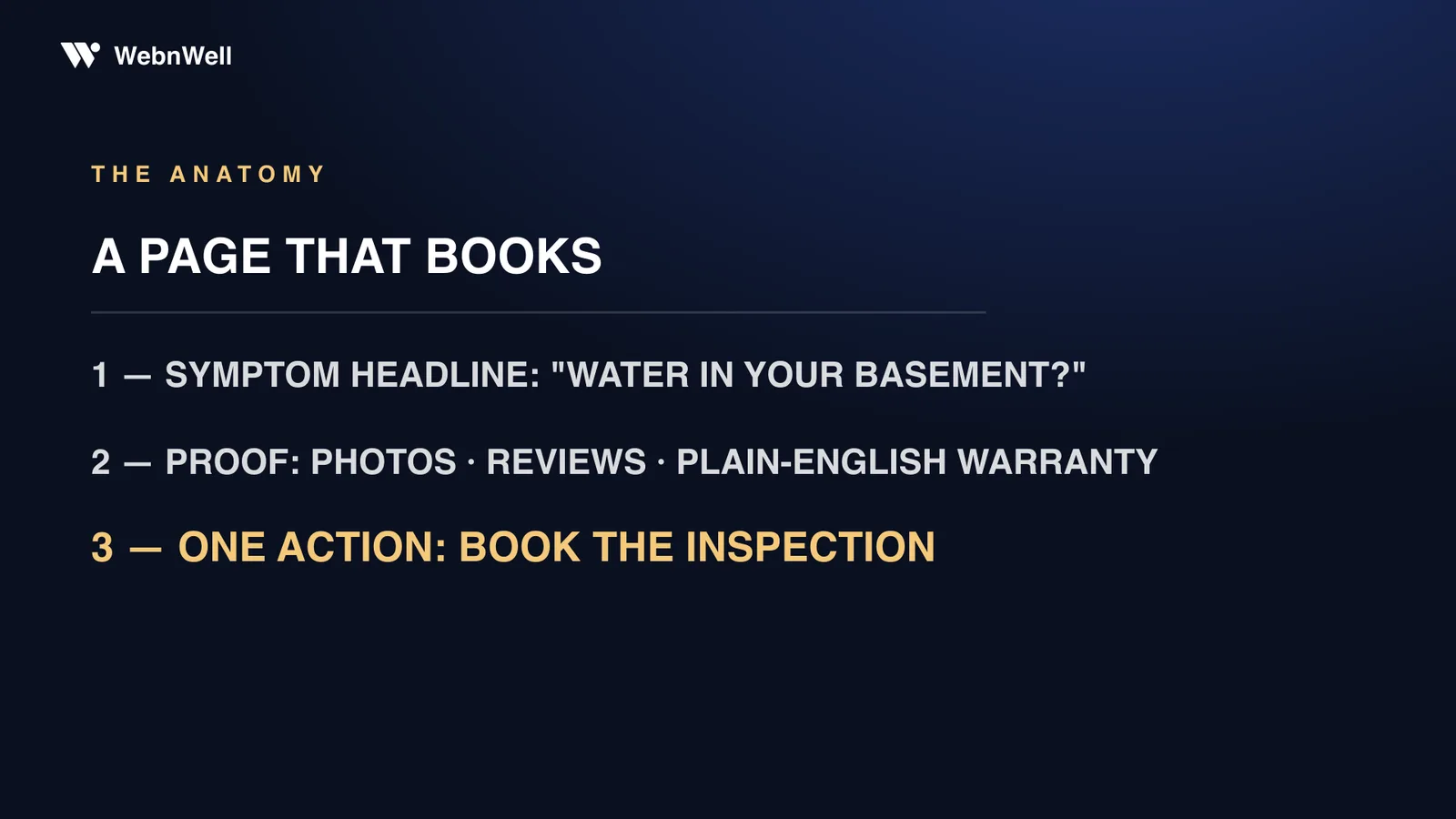
Symptom headline, proof, one action. If a page element doesn’t help a nervous homeowner decide to book an inspection, it’s decoration.
The match discount: pay less for the same click
The part almost nobody explains to owners, and my favorite part, is that problem pages don’t just convert better. They usually make the clicks themselves cheaper.
Google grades every ad on how well the search, the ad, and the page line up. They call it a quality score, but “match grade” is closer to the truth. When someone searches “bowing basement wall” and your ad sends them to a page genuinely about bowing basement walls, Google reads you as the more relevant answer. Relevant answers tend to pay less per click and show more often. Mismatched advertisers pay a premium for the same spot. You’re being graded either way; you might as well be graded on a match.
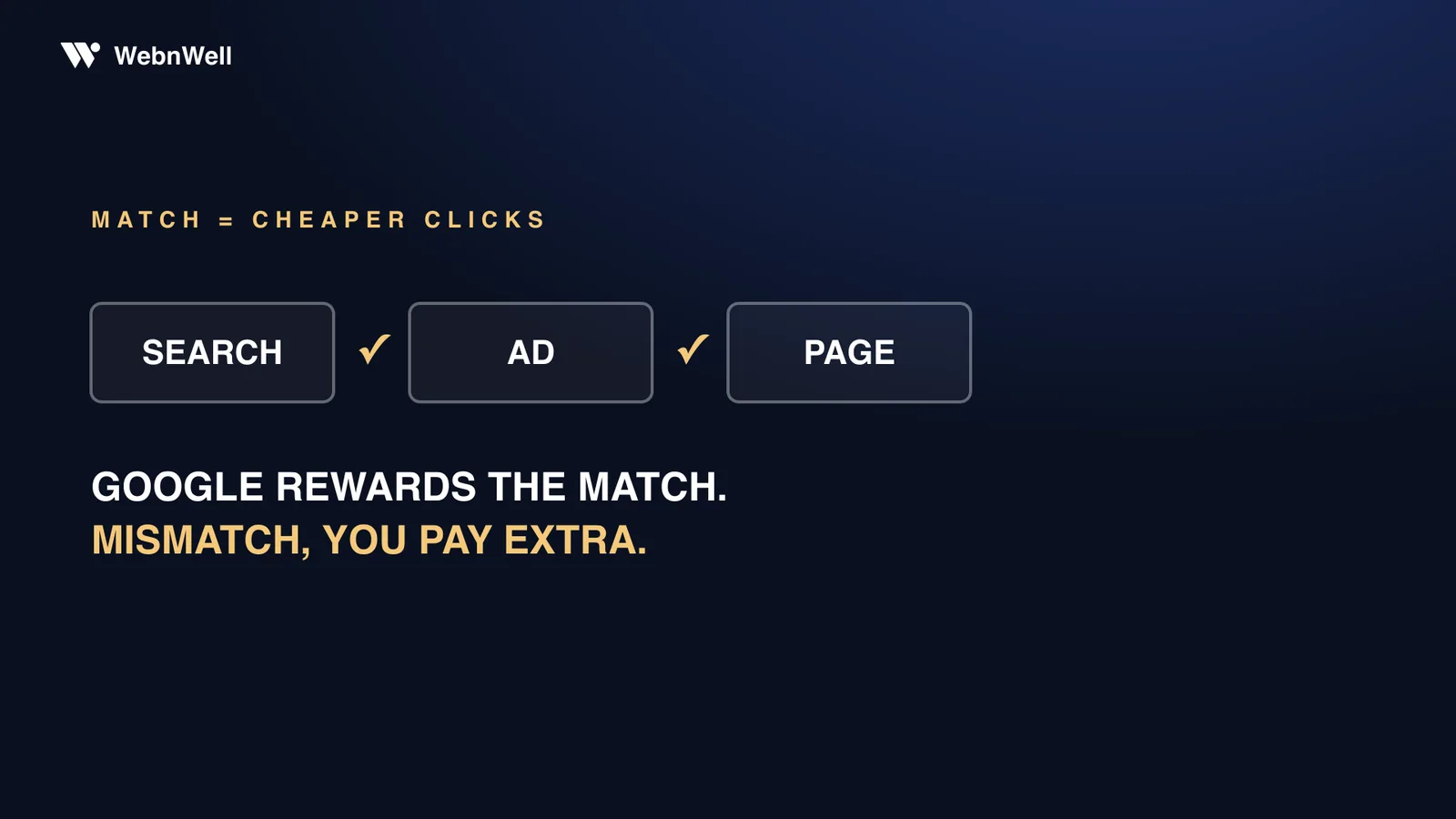
Then the conversion side stacks on top. On paper it looks like this (the figures in the table are invented to keep the arithmetic clean; rerun it with your own click cost and close rate):
| Generic homepage | Wet-basement problem page | |
|---|---|---|
| Clicks bought (at an example $40/click) | 100 → $4,000 | 100 → $4,000 |
| Visitors who request an inspection | 1 in 25 → 4 leads | 1 in 10 → 10 leads |
| Cost per lead | $1,000 | $400 |
Same ad. Same spend. The page alone moved cost per lead by 2.5x, and that’s before the match discount on the clicks themselves, which widens the gap further. This is why “just raise the budget” is usually the wrong first move: more money through a mismatched page just buys mismatches faster.
The conversion numbers aren’t fantasy, either. When we rebuilt pages for a client called My German University, education consulting, about as far from foundation repair as it gets, and their landing pages settled in at 30–36% conversion, with cost per conversion improving 85%. I’m not promising those figures for your market; different industry, different math. But the direction travels, because the principle is the same: match the page to the person.
A matched page gets paid twice: once when more visitors book, and again when Google charges you less for the same clicks.
Which page do you build first?
Don’t build all five in a weekend. You’ll rush them, and five mediocre pages lose to one good one.
Pick the first page where two things overlap: the jobs you most want more of, and the searches your market really makes. For most waterproofing-leaning companies that’s the wet-basement page; rain drives search spikes you can practically set a calendar by. For structural crews it’s usually bowing walls or foundation cracks, because those searches carry the most fear and the most urgency.
You don’t need a research budget to check. Type your area’s symptoms into Google and watch the autocomplete. That dropdown is homeowners in aggregate, telling you what they’re worried about. Build the one page, point one campaign at it, and watch one number: inspection requests per hundred visitors. When it’s booking, build the next.
Boring, sequential, measurable. And it compounds, because every finished page keeps booking inspections while you build the next one.
Which searches deserve their own page first
If you’d rather see the actual list than guess, that’s what our free foundation market audit is for: it maps the searches in your area that are currently being dumped onto your homepage and shows which ones have earned a page of their own. You get a recorded breakdown of your market and your site, seen the way a homeowner sees them — ten minutes to watch, yours to act on whenever you’re ready.