
“What should my budget be?” is the first question on almost every strategy call we take, and after 1,400+ campaigns for local service businesses, here’s the honest answer up front: anyone who quotes you a number before asking about your business is guessing. There’s no correct figure for “a contractor,” only the correct figure for your job value, your close rate, and your market’s click prices. Working it out takes five minutes and fits on a napkin. This is that napkin.
The right Google Ads budget is an output of your math, not an input. A number quoted before anyone asks what a job is worth to you is a guess.
Start from the job, not the budget
Work backwards from three numbers you already know:
- Average job value. What’s a typical signed job worth? A $3,000 bathroom refresh, a $12,000 foundation repair, a $40,000 kitchen?
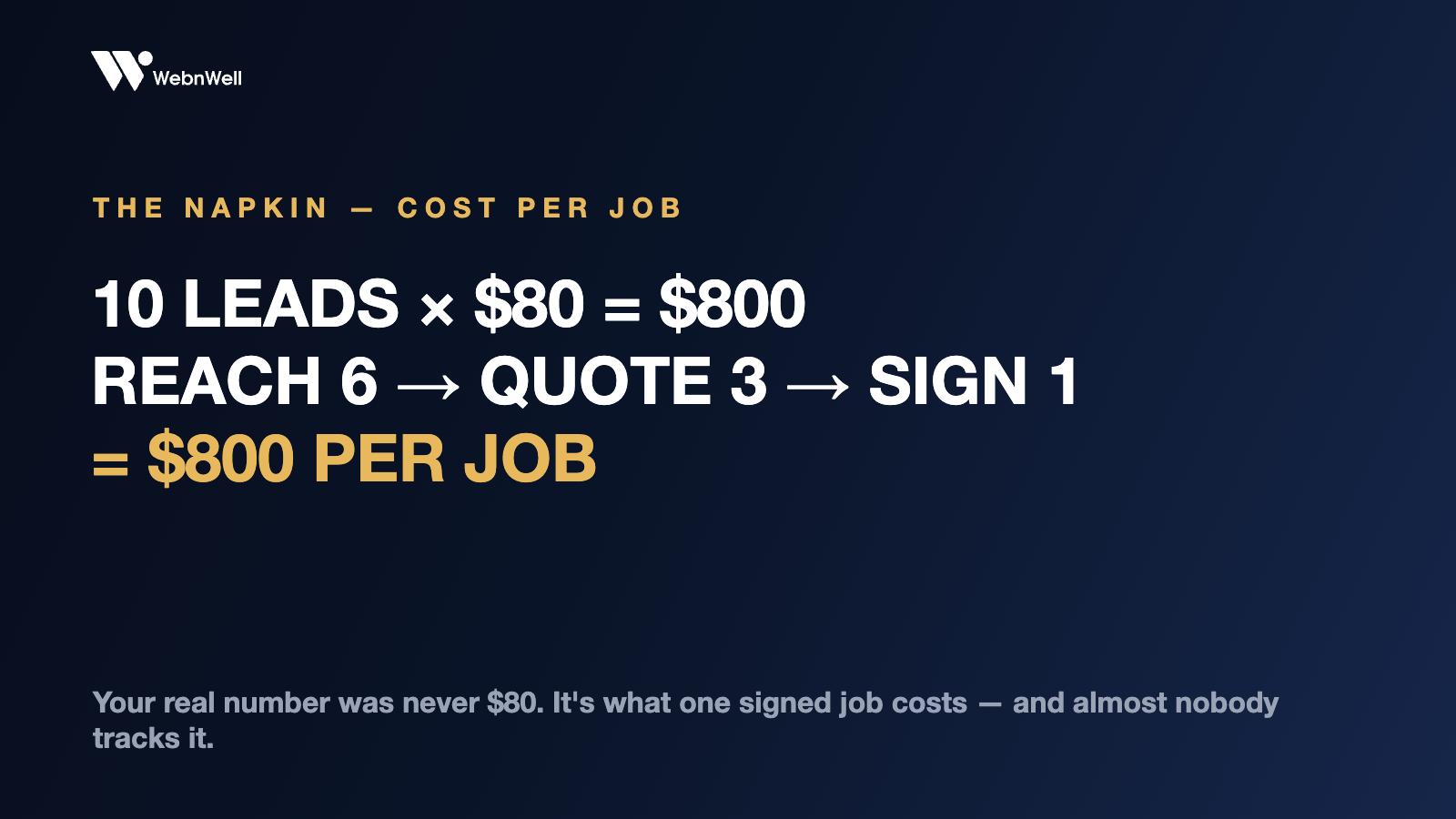
- Close rate. Of the qualified leads that reach you, how many become customers? If you don’t know yours, count your last ten qualified leads and how many of them signed. That fraction is worth more than any industry average. The worked example below uses one in three. Be honest with it: the napkin only works with real numbers.
- What a customer is worth paying for. Take the profit in a job, decide how much you’d trade to win it, divide by your close rate. That’s your allowable cost per lead, the ceiling under which every dollar is margin.
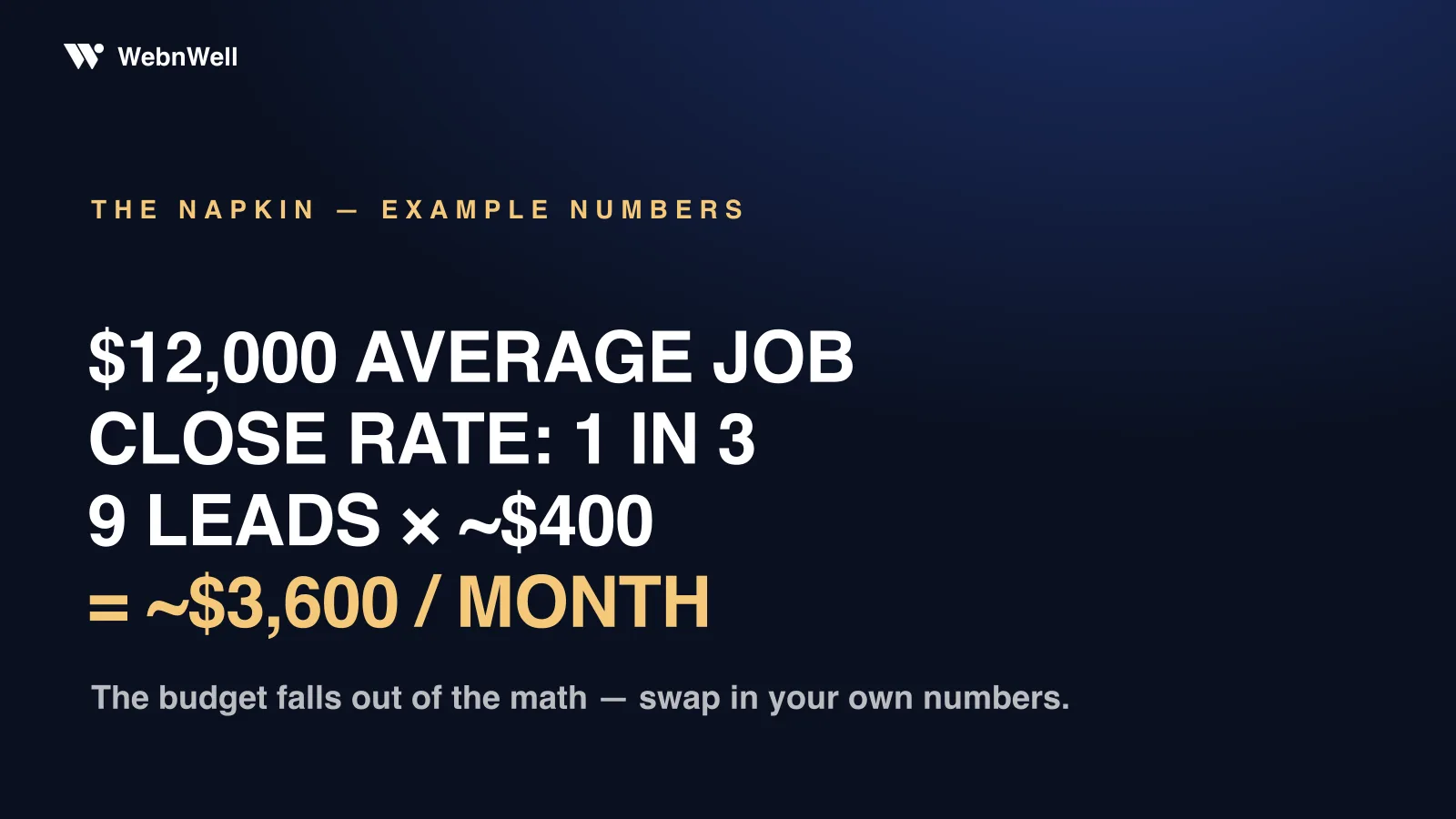
Here’s the whole napkin for a hypothetical foundation contractor averaging $12,000 a repair (every number is an example, swap in your own):
| Step | Number | Where it comes from |
|---|---|---|
| Average job value | $12,000 | Your books |
| Gross profit per job (say 45% margin) | ~$5,400 | Your books |
| What you’d pay to win one job (say a third of that profit) | ~$1,800 | Your decision |
| Close rate on qualified leads | 1 in 3 | Your CRM, or your gut honestly audited |
| Allowable cost per lead | ~$600 | $1,800 ÷ 3 |
| Realistic cost per lead (say $40 clicks, page converts 1 in 10 visitors) | ~$400 | $40 × 10 |
| Jobs you want from ads each month | 3 | Your capacity |
| Leads needed | ~9 | 3 jobs × 3 leads per job |
| Starting monthly budget | ~$3,600 | 9 leads × ~$400 |
The budget fell out of the math; nobody picked $3,600 because it “felt right.” Notice also how sensitive it is. If the page converts one in twenty instead of one in ten, the same budget buys half the jobs. The budget is the least interesting number here, and the numbers around it decide whether it works.
What clicks actually cost — and why waste compounds
Clicks in competitive local trades cost far more than most owners expect before they look. For the worked examples in this guide we’ll use $40 a click, and you should replace that with the real number for your market (it’s one of the first things we pull on a strategy call). At those prices, every leak compounds fast:
Wrong-intent clicks. “How to fix a foundation crack myself” costs roughly the same as “foundation repair company near me,” but one is a customer and the other is a weekend warrior comparing epoxy kits. Say fifteen DIY searchers click your ad in a month at $38 a click: $570 spent on people who were never your buyers. Without an aggressive negative-keyword list, this eats most self-managed accounts.
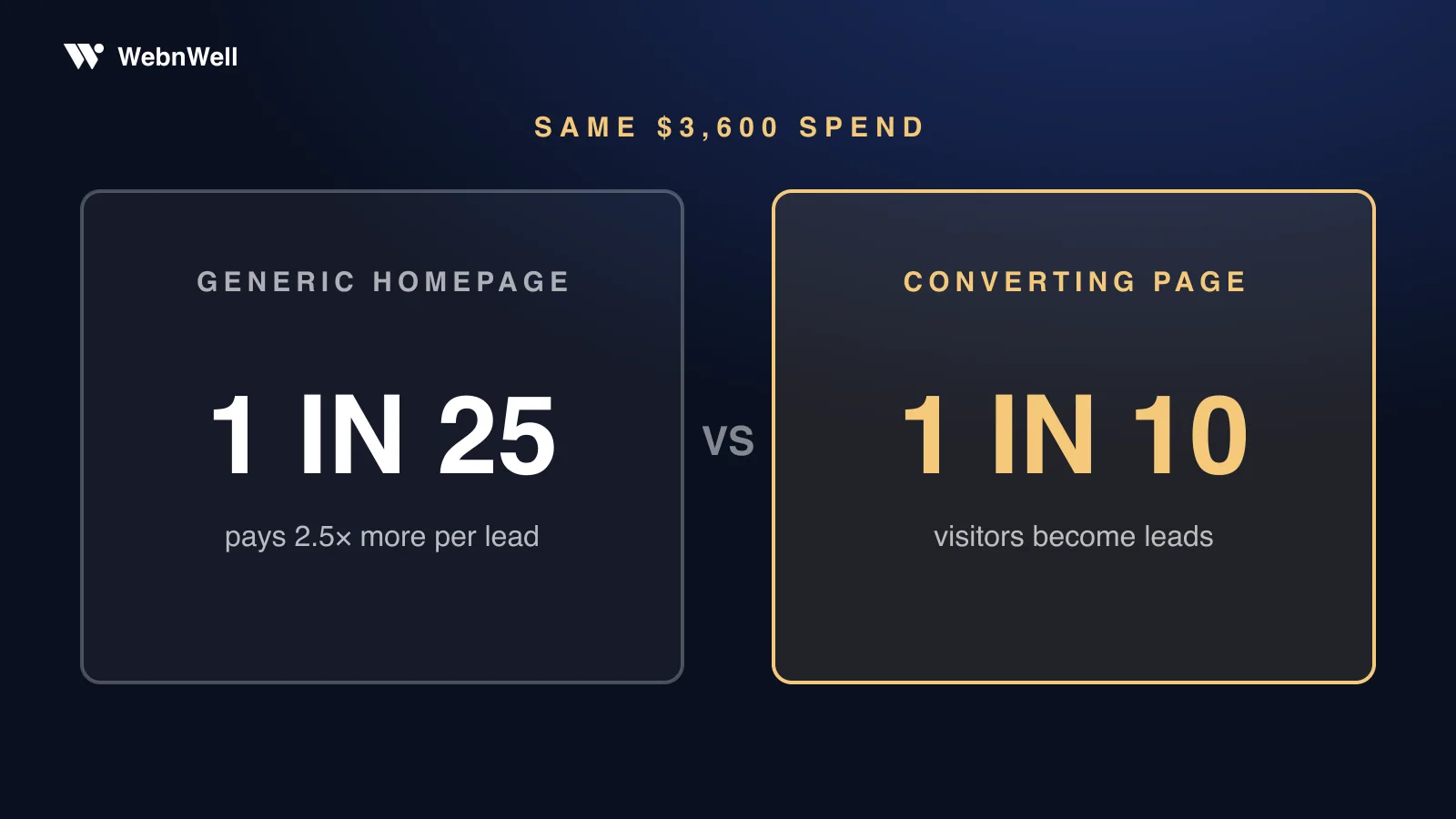
Leaky landing pages. Picture two contractors spending the identical $3,600. One sends clicks to a page that converts one visitor in ten; the other, to a generic homepage converting one in twenty-five. Same spend, yet the second pays two and a half times more per lead and concludes “Google Ads doesn’t work.” Doubling budget on a leaky page doubles the waste. Fixing the page cuts cost per lead at the same budget.
Slow follow-up. A homeowner with a cracked foundation fills out three forms in ten minutes. The contractor who calls back first usually gets the site visit; response studies have shown for years that the odds collapse within the first hour. More leads answered slowly are just more leads your competitor books. We wrote a whole piece on speed to lead because it’s the cheapest fix here.
This is why we treat budget as the last dial, not the first. When a roofing contractor came to us, the win was 61 exclusive leads in the first 30 days at a 25% lower cost per lead — targeting and conversion work, not extra spend. Another client, BlastOff360, pulled 66 conversions from $1.2k in spend (roughly $19,800 in tracked value) on a budget many agencies would call too small to bother with.
Budget is the last dial we touch. Fix intent, the page, and the follow-up first — then more spend multiplies a working machine, not a leaking one.
The three budget mistakes we keep seeing
1. Spreading the budget across every service at once. A remodeler with $2,000 a month splits it across kitchens, bathrooms, decks, and additions. That’s $500 each, about one click per service per day. Nothing gets enough data to learn, so everything underperforms and the channel gets blamed. Pick the service with the best margin and fastest close, win there first, then expand with the profits.
2. Judging the account in week two. If your average job takes three weeks from first call to signed contract, two weeks in you haven’t completed one sales cycle. Obvious waste does show up fast: when Pacific Rigging Loft came to us, the account stopped losing money within 3 days and tracked around 25 calls in the first week. But proving your cost per job takes at least one full sales cycle, usually two. Know which one you’re measuring.
3. Setting the budget from what a competitor “must be spending.” You can see their ads; you can’t see their close rate, average ticket, margins, or whether their campaign is profitable at all. Plenty of loud advertisers are losing money loudly.
Your competitor’s budget is the answer to their math. You don’t know their math — and half the time, neither do they.
The phased framework: test, prove, scale
Here’s how we structure it:
| Phase | Rough timeline | What to expect | Exit criteria |
|---|---|---|---|
| Test | Days 1–90 | We size testing budgets to buy roughly 10–15 clicks a day; below that, in our experience, an account learns too slowly to improve. Cost per lead swings week to week; expect weekly search-term cleanup and some tuition paid to the learning curve. | Tracking proven end-to-end, negative-keyword list built from real search terms, a believable cost per lead emerging. |
| Prove | Days 60–180 | Cost per lead steadies. The work shifts to the pipeline: tying every lead to a quoted and signed job so you know your true cost per job. Untracked spend is unaccountable spend, no exceptions. | A known, profitable cost per job held across at least one full sales cycle. |
| Scale | Ongoing | Raise budget in steps (we like 20–30% at a time) and watch whether cost per job holds. It usually rises as you buy deeper into the auction; the question is whether the marginal job is still profitable. | None. This phase is the business model working. |
Scaling this way is boring, and boring is the point. One of our clients, Yaba Cisse of On-Site Equipment Training, described his results as roughly an 8x return on ad spend: $1,000 in, $8,000+ back, in his words. Ratios like that are built by refusing to scale anything unproven. It’s also why our own optimization software checks every account daily. Drift caught on day one costs a click, not a month’s budget.
Questions owners actually ask
Is $1,000/month enough?
Depends on your click cost. At our example’s $40 click, $1,000 buys about 25 clicks a month. One click a day is not a campaign; it’s a lottery ticket with extra steps. In cheaper niches with tight geography, $1,000 can genuinely work. If it’s truly the ceiling in an expensive niche (legal keywords are the extreme case), narrow to your best service in your best zip codes, or save until you can fund a real test. A drip budget mostly buys frustration.

Should I pause ads in slow season?
Usually no. Trim, don’t pause. The jobs you close today come from leads generated weeks ago; pausing digs a hole that appears right when season turns and you need the pipeline full. Slow season also thins the auction, which often means cheaper clicks for whoever stays in. Cut to a maintenance budget, tighten to your highest-intent keywords, keep the machine warm. The exception: if you truly cannot take on work, paying for leads you’ll ignore is worse than pausing.
Google suggested I raise my budget — should I?
Treat Google’s budget prompts like a car dealer’s advice to buy the bigger engine: sometimes right, never neutral. Those prompts exist to capture more auction volume, and Google has no idea what your close rate or margins are. The only trigger for raising budget is your own napkin: tracked cost per job profitable, impression share being lost on your best keywords. If a machine-generated banner is the only reason, decline politely.
Google’s budget suggestions optimize for auction volume, not your cost per job. Raise your budget when your own tracked math says the next dollar is profitable — not before.
The one rule that matters
Never set a budget you can’t track to revenue. The businesses that win with Google Ads aren’t the ones that spend the most; they’re the ones that know exactly what a lead costs, what a job is worth, and cut everything in between that doesn’t connect the two. Everything above is that one rule wearing different clothes.
If you want the napkin math done for your business, with your market’s real click prices instead of our example numbers, that’s what a free strategy call is for — the same starting point as our marketing for foundation and waterproofing contractors. We’ll tell you what we’d spend, where, and what we’d expect back. No long-term contracts, and the ad account is yours either way.