
Here’s a pattern we see in almost every local service account we take over: the ads are decent, the landing page is fine, the leads are coming in. And a worrying share of them book with a competitor anyway.
The owner blames the ads. The platform blames the landing page. Nobody compares the timestamp on the lead notification with the timestamp on the first call back. When we pull those two numbers side by side in a new account, the gap is routinely hours. Sometimes days. The leads weren’t bad. They were fresh when they arrived and stale by the time anyone touched them.
The reason those jobs walked is almost never price. It’s response time.
The problem, in one evening
A homeowner is loading the dryer and notices a stair-step crack running up the basement wall. She takes a photo, sits down at the kitchen table, and searches “foundation crack repair near me.” This is a five-figure decision, so she does what everyone does with a five-figure decision: she contacts more than one company.
Here’s the timeline.
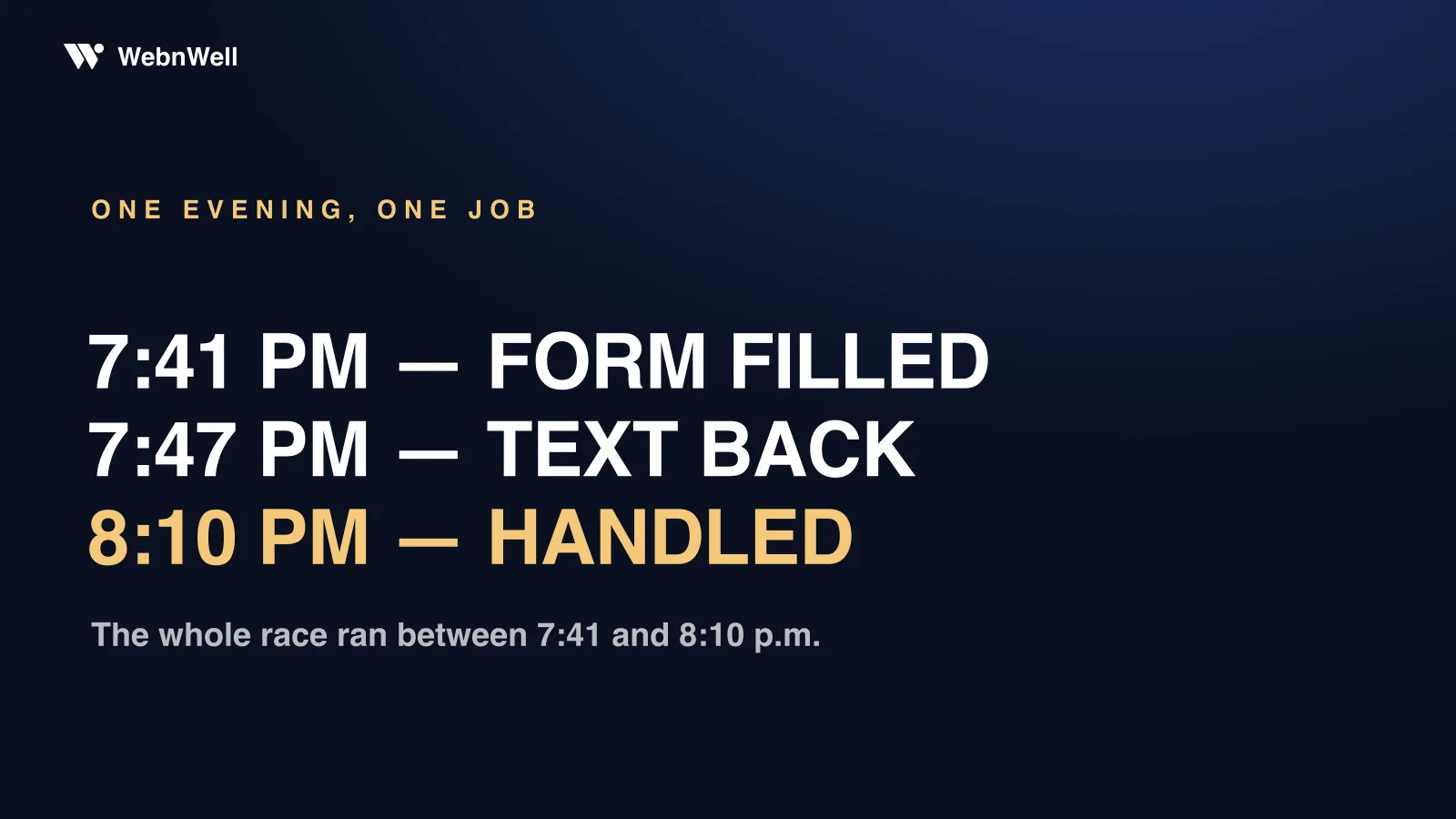
7:41 p.m. She fills out the form on Company A’s website. Nice site, good reviews. “We’ll be in touch shortly.” Her submission lands in an email inbox nobody will open until tomorrow.
7:44 p.m. She calls Company B. Four rings, then a voicemail listing office hours: Monday to Friday, 8 to 5. She doesn’t leave a message. Almost nobody does.
7:46 p.m. She fills out the form on Company C’s website.
7:47 p.m. Her phone buzzes. A text from Company C: “Got your request about the foundation crack. Can we call you in the next ten minutes?” She replies “yes.”
7:56 p.m. Company C calls. The rep asks how long the crack has been there, whether there’s water in the basement, whether the doors upstairs still close, then books an inspection for Thursday at 9 a.m.
8:10 p.m. She closes the laptop. In her mind, this is handled.
Next morning, 9:15 a.m. Company A opens the inbox and calls. She’s polite: “Thanks, but we already have someone coming out.” Company A logs it as “lead didn’t convert.”
The ads worked fine. Company A paid real money for that click, and Company C won the job with a text that took thirty seconds to set up.
If your lead sits in an inbox for 40 minutes, you didn’t lose to a better contractor. You lost to a faster phone.
What “fast” means in minutes
We’re not going to invent a statistic here. But response-time research has been making the same point for years: the odds of ever qualifying a lead collapse within the first hour, and the steepest drop happens in the first few minutes. Our own client accounts show the same shape: when we’ve cut response time from “whenever someone checks email” to under five minutes, booked-appointment rates move immediately, with zero change to the ads.
The more useful question is why the first responder wins so consistently. Four things happen on that first call, and they compound:
They frame the problem. The first company to talk to the homeowner gets to define what she’s dealing with, in their vocabulary, on their terms. Every later conversation is measured against that framing.
They book the slot. Once an inspection is on the calendar, inertia switches sides. Every competitor who calls afterward is asking her to do something (cancel, compare, reschedule). The first responder only needed her to do nothing.
They set the anchor price. The first number she hears becomes the reference point. Everyone who quotes after that is either “expensive” or “suspiciously cheap” against an anchor they never got to place.
They earn the halo. Before price is ever discussed, the homeowner has run a quiet test: if this is how they answer a form, this is how they’ll handle my job. The company that responded in six minutes is “the responsive one” from that point on, and responsiveness is the closest thing to a trust signal a stranger can give.
None of this requires being better, cheaper, or more established. It requires being first.
You don’t need to beat your competitor’s marketing budget. You need to beat their reaction time.
The real math of slow follow-up
Let’s put numbers on it. A worked example, not your numbers, but plug in your own and the shape won’t change.
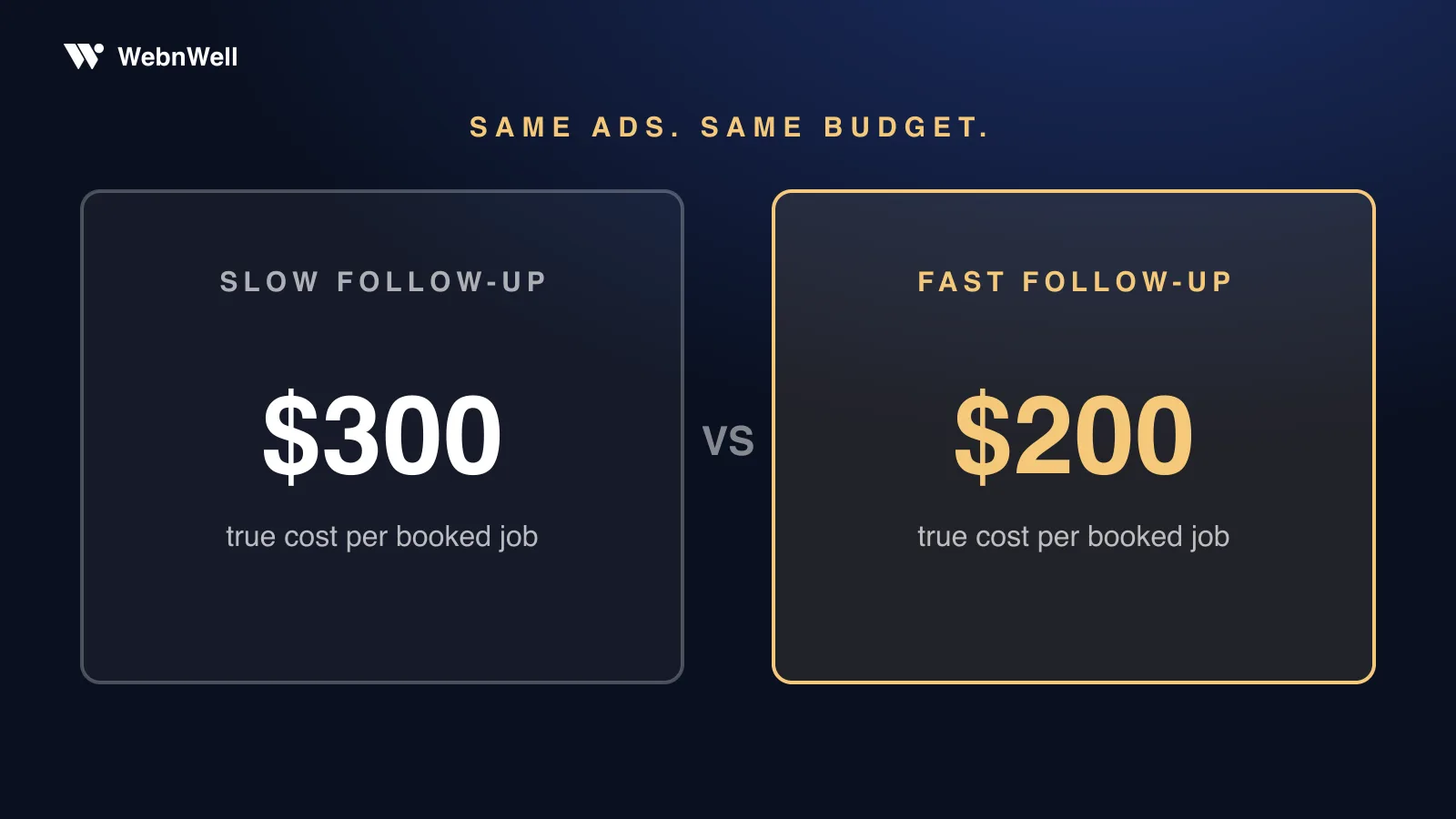
Say you’re generating 30 leads a month at $80 per lead, and when you reach a lead quickly, about 4 in 10 book a job. Now run the same account with slow follow-up, where a third of leads book elsewhere before you ever have a real conversation:
| Fast follow-up | Slow follow-up | |
|---|---|---|
| Leads per month | 30 | 30 |
| Ad spend (at $80/lead) | $2,400 | $2,400 |
| Leads lost before a real conversation | 0 | 10 |
| Leads you truly compete for | 30 | 20 |
| Booked jobs (4 in 10 book) | 12 | 8 |
| True cost per booked job | $200 | $300 |
Same ads. Same budget. Same landing page. Your true cost per booked job just went up 50%, and that increase never appears in any ad report, because the platform counted all 30 leads as conversions.
Extend it one step: if your average job is worth $10,000, those four lost bookings are $40,000 a month that went to whoever answered first. Most owners respond by raising the ad budget, which, with slow follow-up, mostly buys more leads to lose.
Slow follow-up is an invisible line item. It never shows up in your ad account. It shows up on your competitors’ schedules.
Five fixes, in order of effort
Most of this is fixable in a week, without new marketing spend.
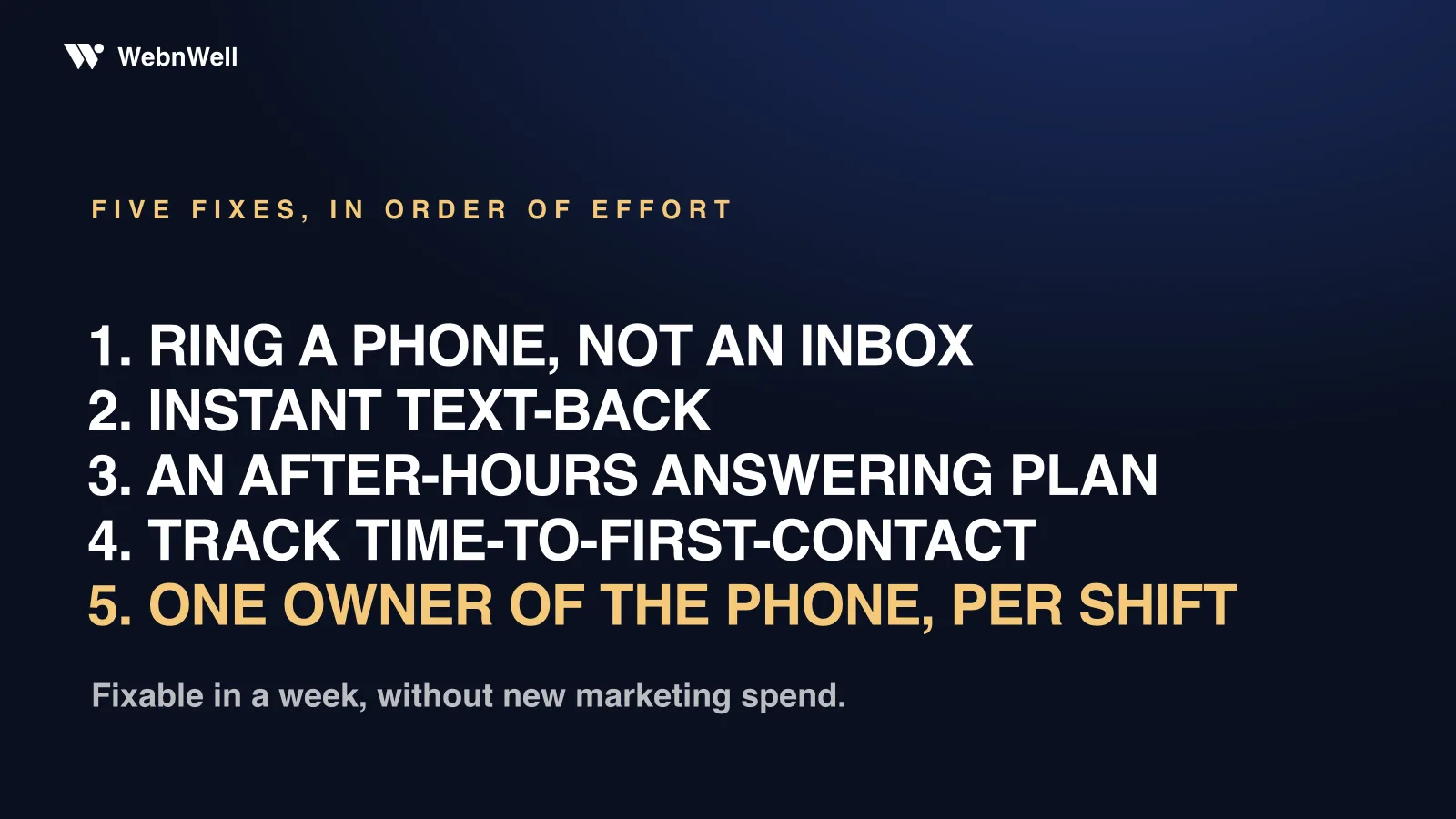
1. Ring a phone, not an inbox. If leads land only in email, you’ve built a delay into your own funnel. This week: change your form notifications so every submission fires a text to the schedule owner’s cell, not just an email.
2. Instant text-back. When nobody can pick up (on a roof, in a crawlspace, at dinner), an automatic text (“Got your request, can we call in 10 minutes?”) keeps you in the race. This week: set up one automated message on your form and your business line. One message. That’s the whole project.
3. An after-hours answering plan. The whole race above ran between 7:41 and 8:10 p.m. Homeowners research at night and on weekends, exactly when most contractors’ phones go to voicemail. This week: decide who covers evenings and Saturdays, a rotating team member or an answering service, and forward the line.
4. Track time-to-first-contact like a KPI. Most owners can quote their cost per lead to the dollar. Almost none can quote their median response time. This week: pull your last 20 leads, compare each submission timestamp with your first call or text back, and write down the median. It’s usually the most uncomfortable number in the business.
5. One owner of the phone, per shift. “Everyone answers the phone” means nobody does. This week: put names on a schedule: one person accountable for first contact per shift, with the response-time number from fix #4 next to their name.
A lead that is everyone’s responsibility is no one’s responsibility. Put a name on every shift.
What we build into every account
Speed-to-lead isn’t advice we hand clients on the way out. It’s wired into every campaign we build, from home remodeling to foundation repair, because ad spend and follow-up speed multiply each other. Across 1,400+ campaigns for local service businesses, we’ve watched fast follow-up rescue mediocre ad accounts far more often than great ads rescue a slow phone.
Every account we run gets three pieces of plumbing:
Missed-call text-back. When a call from your ads goes unanswered, the lead gets an automatic text within moments, so a missed ring becomes a conversation instead of a competitor’s opportunity.
Instant lead alerts. Every form fill and tracked call pushes a notification to your team in real time, timestamped, so response time is visible instead of guessed.
Nurture sequences. Leads that don’t book on the first touch get a short, human follow-up sequence by text and email, because “not yet” and “no” are different answers, and most companies treat them as the same one.
The tracking matters as much as the speed. When we took over the account for Pacific Rigging Loft, it stopped losing money within 3 days, and roughly 25 tracked calls came in the first week. Not estimated, tracked: which ad, which keyword, which call. That’s the visibility that makes a response-time number possible at all.
We’re a Google Premier Partner, we work with no long-term contracts (30 days’ notice), and you own your ad account and your site. The system has to keep earning its place every month, the same way your phone has to keep beating your competitors’ every evening.
The cheapest growth lever you have
Before you spend another dollar on ads, find out what happens in the first ten minutes after someone asks for help. Fixing that is nearly free, it compounds with every lead you already pay for, and your competitors are almost certainly ignoring it.
If you want to know how your own funnel holds up, that’s exactly what we look at in a free strategy call, response time included. For foundation and basement waterproofing companies, it’s one piece of the wider basement and foundation marketing review.