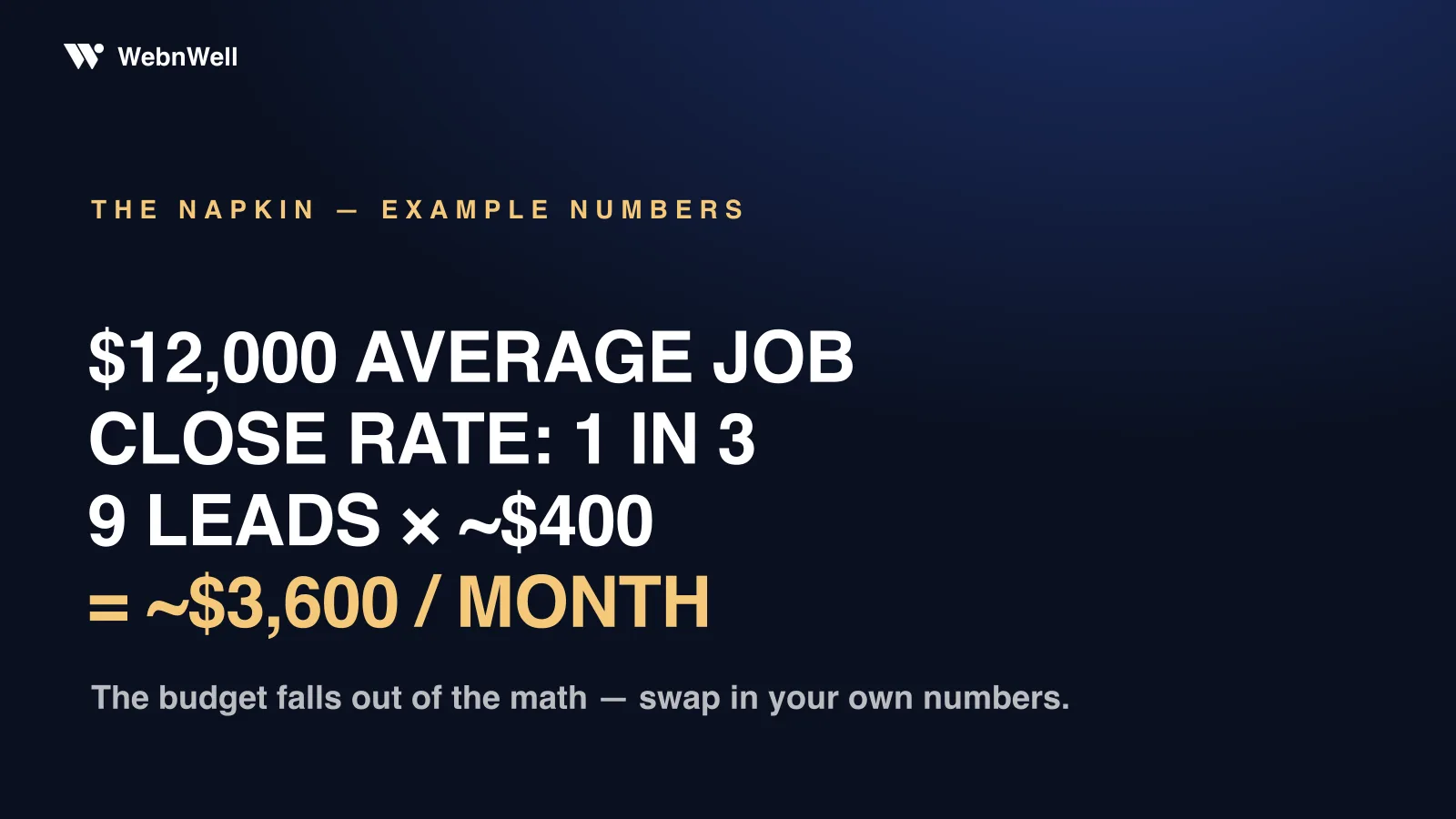

“How much should I spend on marketing?” has no answer as asked. Five hundred dollars is reckless for one company and pocket change for another on the same street.
The question that does have an answer: what can one signed job afford to cost you? Get that, and the budget calculates itself in about five minutes. This is a short post because the math is short.
The whole calculation
Your average invoice, say $14,000. Your rough margin, say 40 percent, so $5,600 stays in the business. The share of that you’ll spend to win the next one; ten percent is a sane starting point for a growing contractor. That makes your ceiling $560 per signed job.
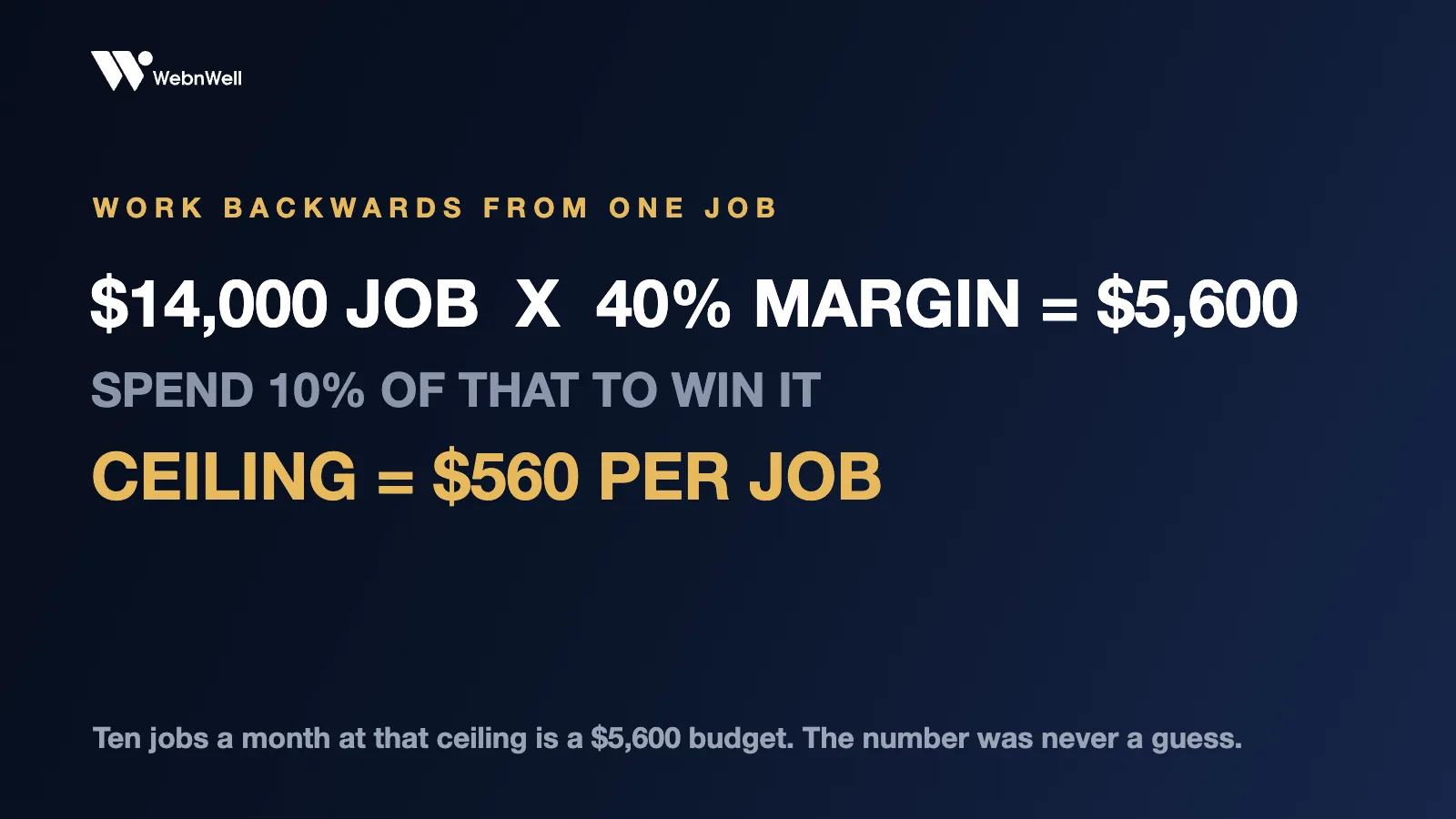
Want ten jobs a month? $5,600 budget. Three jobs? $1,680. Done.
Play it through a real season to see why this beats guessing. Suppose spring brings you eight jobs from $4,200 of spend; that’s $525 a job, under your $560 ceiling, so the machine is working and the right move is more fuel, not caution. Then August comes in at four jobs from the same $4,200. Now you’re at $1,050 a job, nearly double the ceiling, and the budget number didn’t change at all. Something downstream did. Maybe leads slowed, maybe answer speed slipped when the crew got busy, maybe the quotes went out and nobody followed up. The ceiling is what tells you a month needs investigating before the bank statement does.
The one prerequisite is knowing your actual cost per job, because if a job costs more to win than your ceiling allows, the budget isn’t the problem and raising it just scales the loss.
Sanity-check against revenue if you like; five to ten percent is the usual contractor range. But if the job math and the percentage disagree, trust the job math and ask why your close rate or invoice size is off.
The floor, and the order
Budgets can be too small to function. Below roughly five clicks a day there’s no signal, only noise, and in most US metros with foundation clicks running $8 to $20, that floor lands around $500 to $800 a month. Under it, don’t split across channels. Fund the free work instead.
Which is also the right order at any budget:
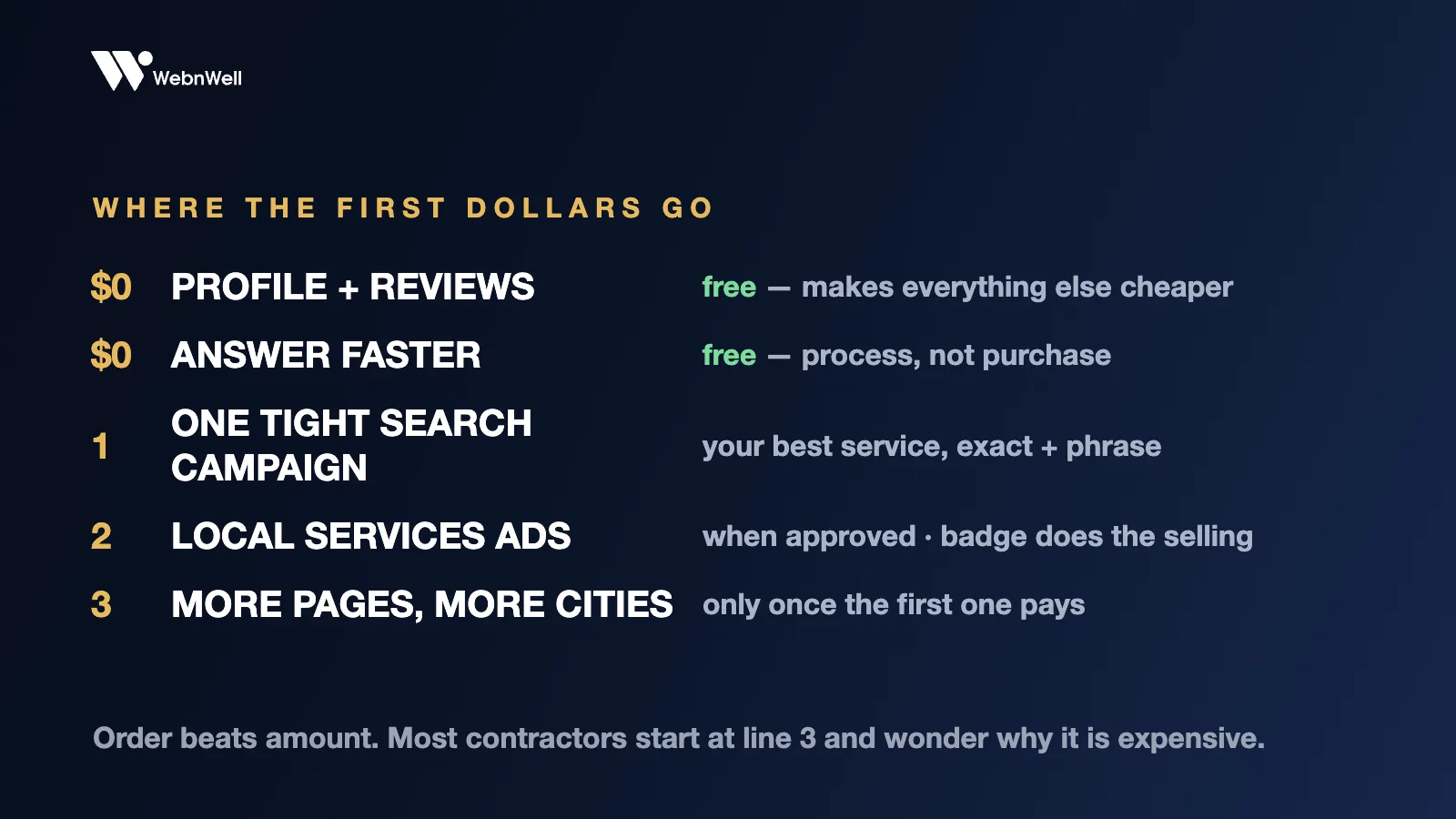
Free: the Business Profile and review habit, which feed the map pack and your future LSA rank. Free: answering leads in minutes, a process change that raises the close rate on every dollar you spend later. Then one tight search campaign on your best service. Then LSA when approved. Then more pages, more cities, once the first campaign pays.
What about agency fees?
If someone manages the ads for you, their fee is part of the acquisition cost, so it goes inside the ceiling, not beside it. A flat $800 management fee on $2,000 of spend means each signed job has to carry its share of $2,800, and that arithmetic is exactly why percentage-of-spend pricing bothers me: it rewards the agency for spending more, not for winning jobs cheaper. Pay flat, keep ownership of your own account, and hold the whole bundle to the same per-job ceiling you’d hold your own time to. If the bundle can’t beat the ceiling, the answer is a different plan and not a bigger number.
When a slow month comes
Resist the pause button. Pausing kills the account’s learning and hands your slot to competitors exactly when demand returns; a campaign at forty percent budget stays alive and warm.
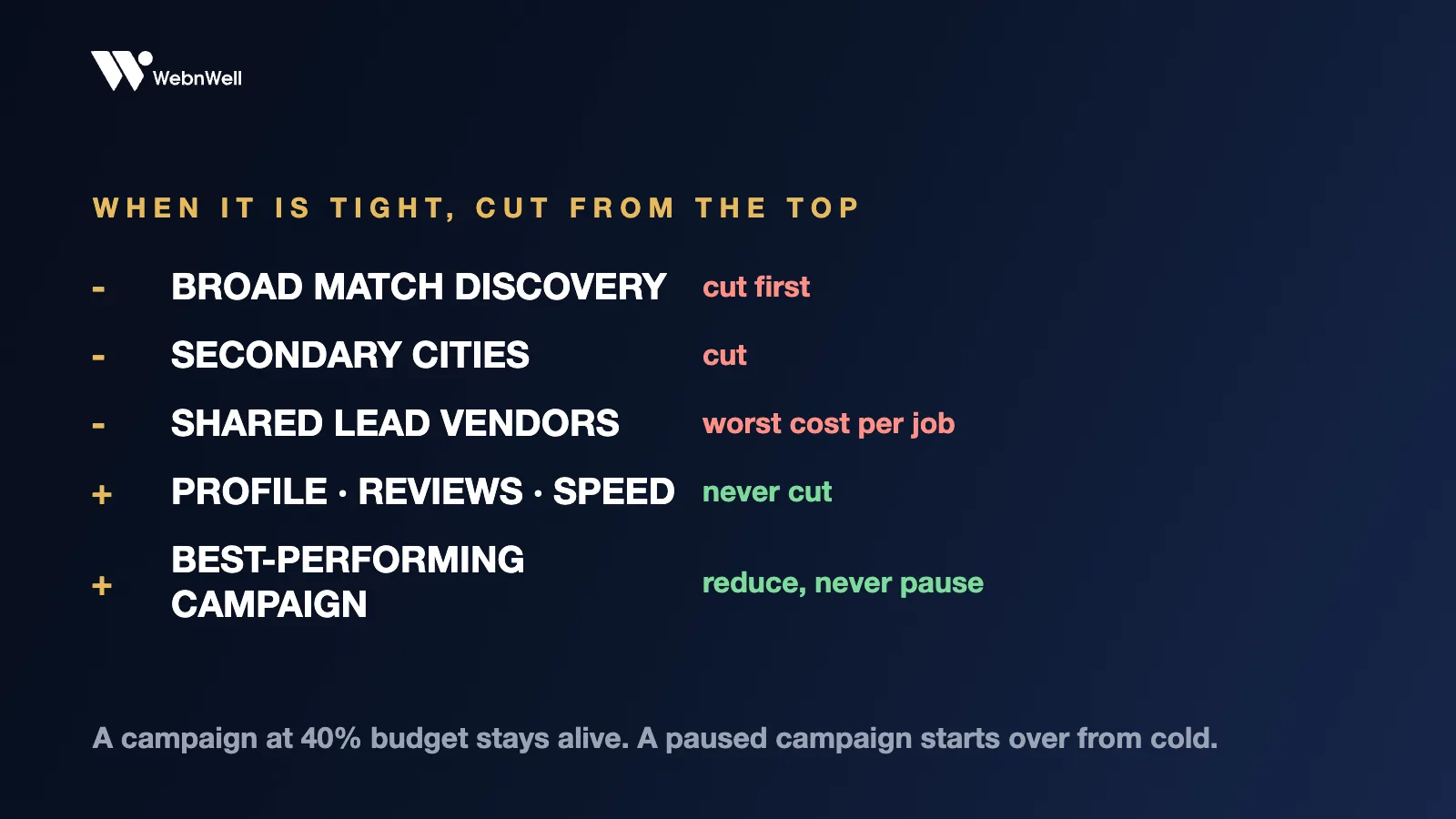
Cut in this order: broad-match discovery, secondary cities, secondary services, shared lead vendors. Keep in every scenario: profile, reviews, response speed, best campaign. Those four are the floor of the business.
That’s the whole method. If you want it run against your city’s real click prices instead of my examples, that’s what the free market audit is for.