

The Challenge
Roofing is one of the most brutal categories in local lead generation. When a storm rolls through or a ceiling stain appears, homeowners search, click, and hire fast — and an entire industry of lead-selling platforms has grown up around that urgency, selling the same homeowner's contact information to multiple contractors at once. The contractor who dials fastest wins the conversation; everyone else paid for a lead that was never really theirs.
RoofCrafters had lived inside that model long enough to know its ceiling. A quality local contractor was competing on speed-to-dial instead of workmanship, paying platform prices for contacts that arrived pre-shopped. What they wanted was structural, not incremental: a pipeline of homeowners who had searched for roofing help, clicked an ad carrying the RoofCrafters name, and asked for RoofCrafters specifically — with every call and form tracked back to the ad that produced it.
The Strategy
- Exclusive by design: Ads under RoofCrafters' own name, sending homeowners to RoofCrafters' own pages and phone number — no lead platform anywhere in the chain, so no lead could ever be shared or resold.
- One campaign per service: Installation, repair, and inspection searches separated into their own campaigns, budgets, and ad copy — because they are different customers.
- A landing page for every service: The page a homeowner lands on says exactly what they searched for. Nothing generic.
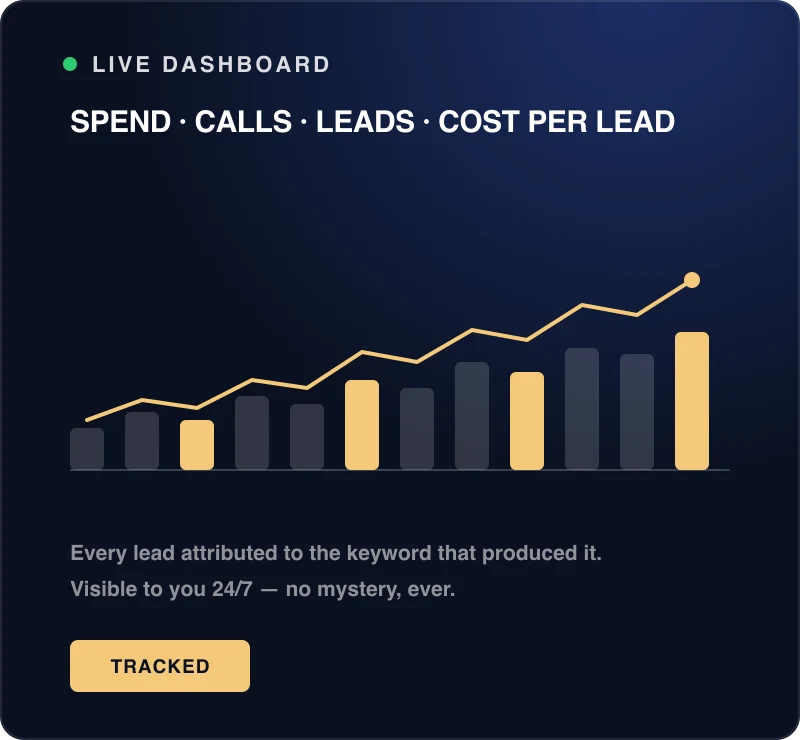
- Track everything: Every call and form tied to the exact ad and keyword, so budget decisions run on evidence, not hunches.
The Playbook
Market and competitor research
Before a single ad went live, we mapped what homeowners in RoofCrafters' service area actually type when a roof fails, what local competitors were bidding on, and where they were overspending on vanity terms. That research draws the boundaries of the entire campaign: spend goes only where intent is high and competition is beatable, which is why the budget worked harder from day one.
Service-specific campaign architecture
"Roof leaking now" and "new roof cost" are different customers with different urgency, budgets, and objections — so they never share a campaign. Splitting installation, repair, and inspection into separate campaigns gave each its own bids, budget, and message, which means an emergency-repair search never drains the budget meant for high-value replacement jobs.
A dedicated landing page per service
Every campaign sent homeowners to a page built for that exact service — repair searches saw repair proof and a fast inspection booking, replacement searches saw process, materials, and a quote request. When the page mirrors the search, more visitors convert and Google rewards the relevance, so this one step lowers cost and raises lead quality at the same time.
The negative-keyword shield
Much of paid-search discipline is choosing what not to pay for. We built and continuously expanded a negative-keyword list that blocked DIY searches, job seekers, material shoppers, and out-of-area clicks before they could spend a cent. Every dollar that shield saved was a dollar redirected toward a homeowner ready to book an inspection.
The weekly optimization loop
From launch onward, ad copy, headlines, page layouts, and calls to action ran in continuous A/B tests, reviewed weekly, with budget flowing toward whatever produced booked inspections at the lowest cost. That loop is why two numbers that usually move together in the wrong direction split apart here: lead volume grew while cost per lead fell 25%.
Why It Worked
Nothing in this playbook is exotic, and that is the honest point: 61 exclusive leads in the first 30 days came from discipline, not from a bigger budget or a secret tactic. Research decided where the money went, campaign architecture kept every search matched to the right message, and the weekly loop compounded small wins into a 25% lower cost per lead.
The exclusivity, meanwhile, was never a promise — it was structural. Because the ads ran under RoofCrafters' own name to RoofCrafters' own pages and phone number, there was no platform in the middle with an incentive to resell the same homeowner. Zero shared leads is not something we had to enforce; it is something the architecture made impossible.