
340 reviews. 19 reviews.
Those are two foundation repair companies in the same market, sitting side by side on a homeowner’s phone. She could be anywhere, at any hour; the scene is always the same two profiles. Next to the first name: 4.8 stars, 340 reviews. Next to the second: 5.0 stars, 19.
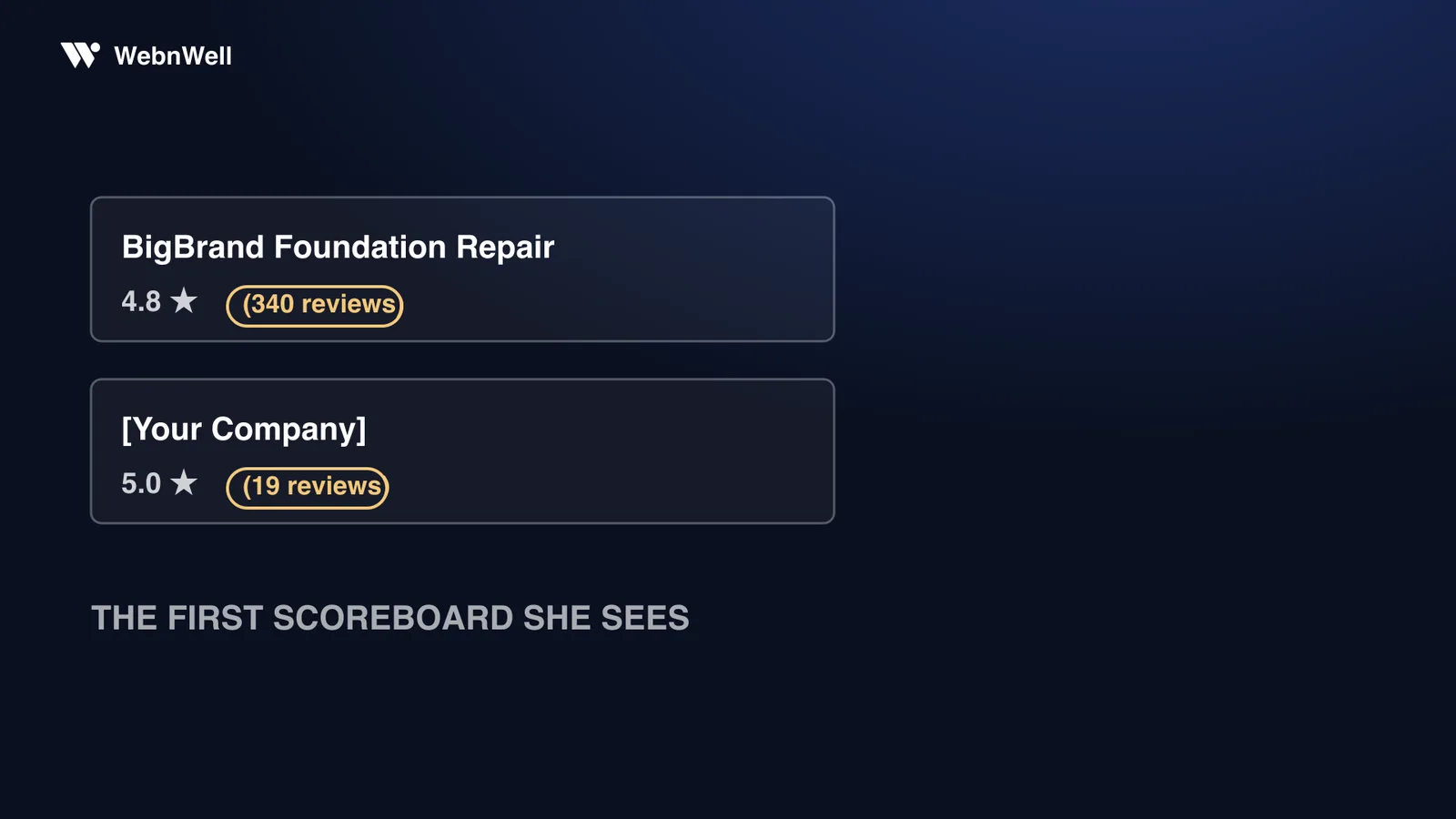
The 19 is you. Every one of them is glowing.
Doesn’t matter. She hasn’t read a word yet. She’s counting. And after 1,400+ campaigns for local service businesses, I can tell you how this usually plays out: the count gets read first, and good contractors get ruled out before their first review is ever opened.
This is the playbook for closing that gap. Not by buying reviews, not by pestering customers, and not by matching a national franchise number-for-number. You won’t, and you don’t need to.
Why the count gets read before the reviews do
Foundation repair sits in the scariest corner of home services. The homeowner can’t see the problem clearly, can’t price it herself, and suspects the wrong choice could cost her the house itself. When people are scared and out of their depth, they don’t research their way to a decision. They grab the fastest signal that other people already took this risk and survived.
Review count is that signal. It’s crude, it’s unfair to good small companies, and it works anyway.
Notice what the count is doing in that side-by-side moment: it isn’t convincing her to hire anyone. It’s helping her rule people out. A wall of reviews says “safe to shortlist.” A handful says “roll the dice”, even when the handful is all five-star. She’ll read the words themselves later, after the count has already cut the field from six companies to two.
A nervous homeowner doesn’t read reviews first. She counts them. The count decides who makes the shortlist; the words only decide between the finalists.
That’s the bad news. The good news is what’s really behind the franchise’s number.
The franchise out-asks you. It doesn’t out-work you.
That wall of 340 didn’t come from 340 delighted customers spontaneously opening Google. Almost nobody leaves a review unprompted — happy customers go back to their lives. The franchise’s number comes from a process: every completed job triggers an ask, sometimes several, the same way every completed job triggers an invoice. Asking isn’t a personality trait over there. It’s a checkbox.
Meanwhile you ask when you remember. Which is roughly never, because at the exact moment your customer is happiest, you’re loading the truck and thinking about tomorrow’s dig.
The math of asking (an example, not a benchmark)
Say you close 12 jobs a month, and say one in three customers you actually ask follows through with a review. Both figures are stand-ins, not benchmarks; run the same table with your real job count:
| Asking when you remember | Asking every job | |
|---|---|---|
| Jobs per month | 12 | 12 |
| Customers asked | 2, on a good month | 12 |
| Reviews left (1 in 3 asked follows through) | 0–1 | ~4 |
| Reviews added in a year | maybe 8 | ~48 |
| Two years out | still “a handful” | past 100, and fresh |
Same company. Same work. Same customers. The only variable is whether the ask happens, and in this example that one variable is worth roughly a hundred reviews over two years.
The table shows something else worth sitting with: you’ll probably never hit 340, and it doesn’t matter. The job is getting out of “handful” territory and keeping the profile fresh. A page adding three or four reviews a month reads as a busy company. A page whose newest review is from two winters ago reads as a company that might not be around anymore.
Ask at the truck
There’s one moment when your customer is most likely to say yes, and it isn’t in an email next Tuesday.
It’s at the truck. The job’s done. The wall is dry, or the crack is sealed, or the floor is level for the first time in years. The customer is standing in the driveway feeling relief, and relief expires. A week later the fixed wall is just a wall, and life has moved on.
So the ask happens right there, face to face, and it sounds like this:
“We’re a local company going up against the big franchises, and reviews are how homeowners find us. Would you take one minute and leave us one? I’ll text you the link right now.”
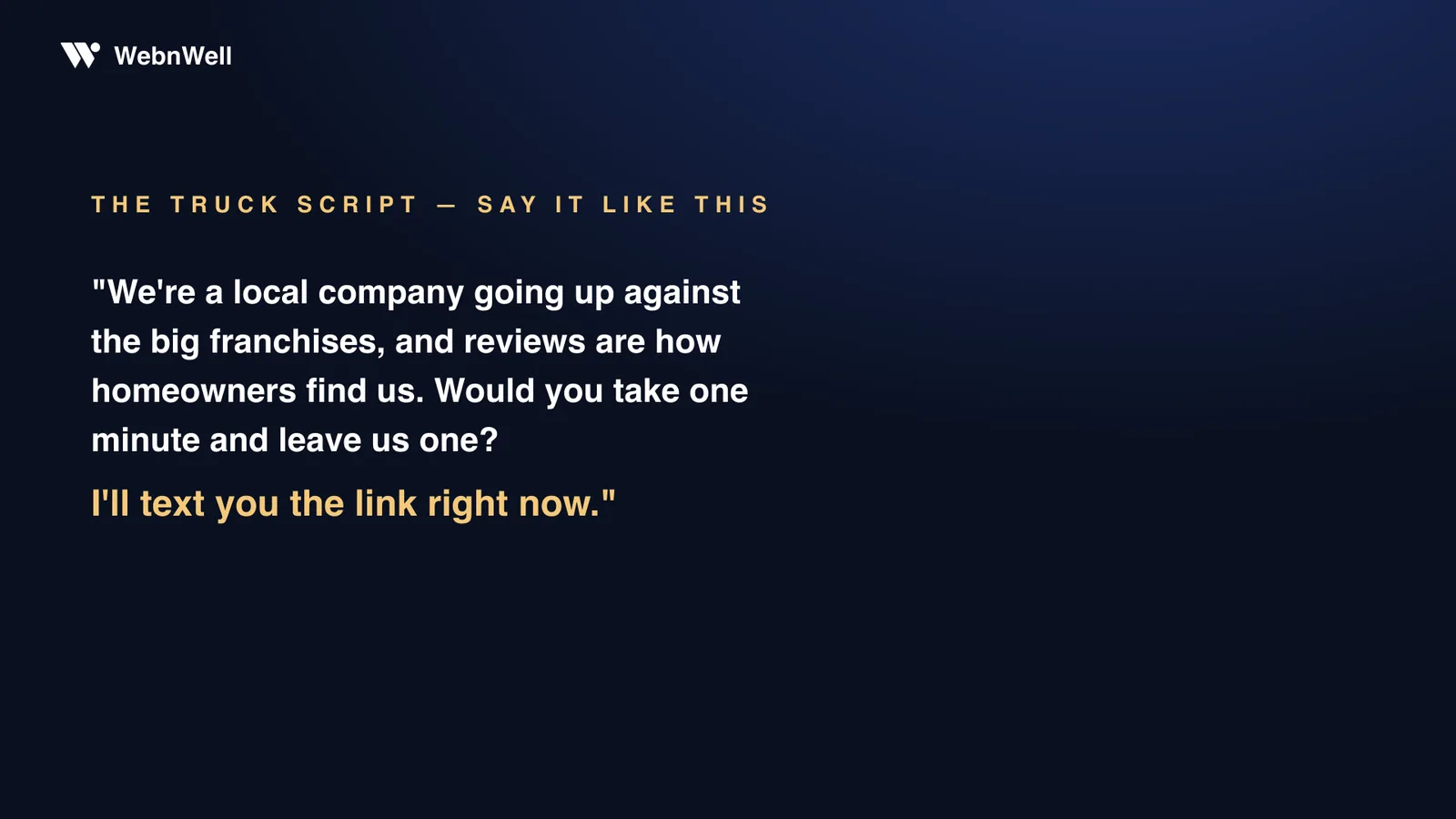
Read it again: three sentences doing three jobs. It names the underdog stakes, because people enjoy helping a local company beat a chain. It sizes the favor honestly: one minute, not “whenever you get a chance.” And it removes every step between yes and done, because the link is about to land in their texts.
You just spent days under their house, fixing the thing everything else they own stands on. They’ll give you sixty seconds. Most owners never find out, because they never ask.
We run the same play ourselves, one level up: we ask our clients to say it on camera, because we’re a small company up against big-agency walls of logos. Same principle: the proof exists, but only if you ask while the win is fresh.
Put the follow-up on autopilot
The face-to-face ask is the habit. The machine behind it is what makes the number climb.
Before your truck is off their street, a text should hit their phone: thanks for trusting us with your foundation, here’s the direct review link. One tap and the review box is open. No searching your company name, no hunting through Google Maps. If nothing happens by day three, one polite nudge goes out automatically. Then it stops. Nobody hires a contractor who nags.
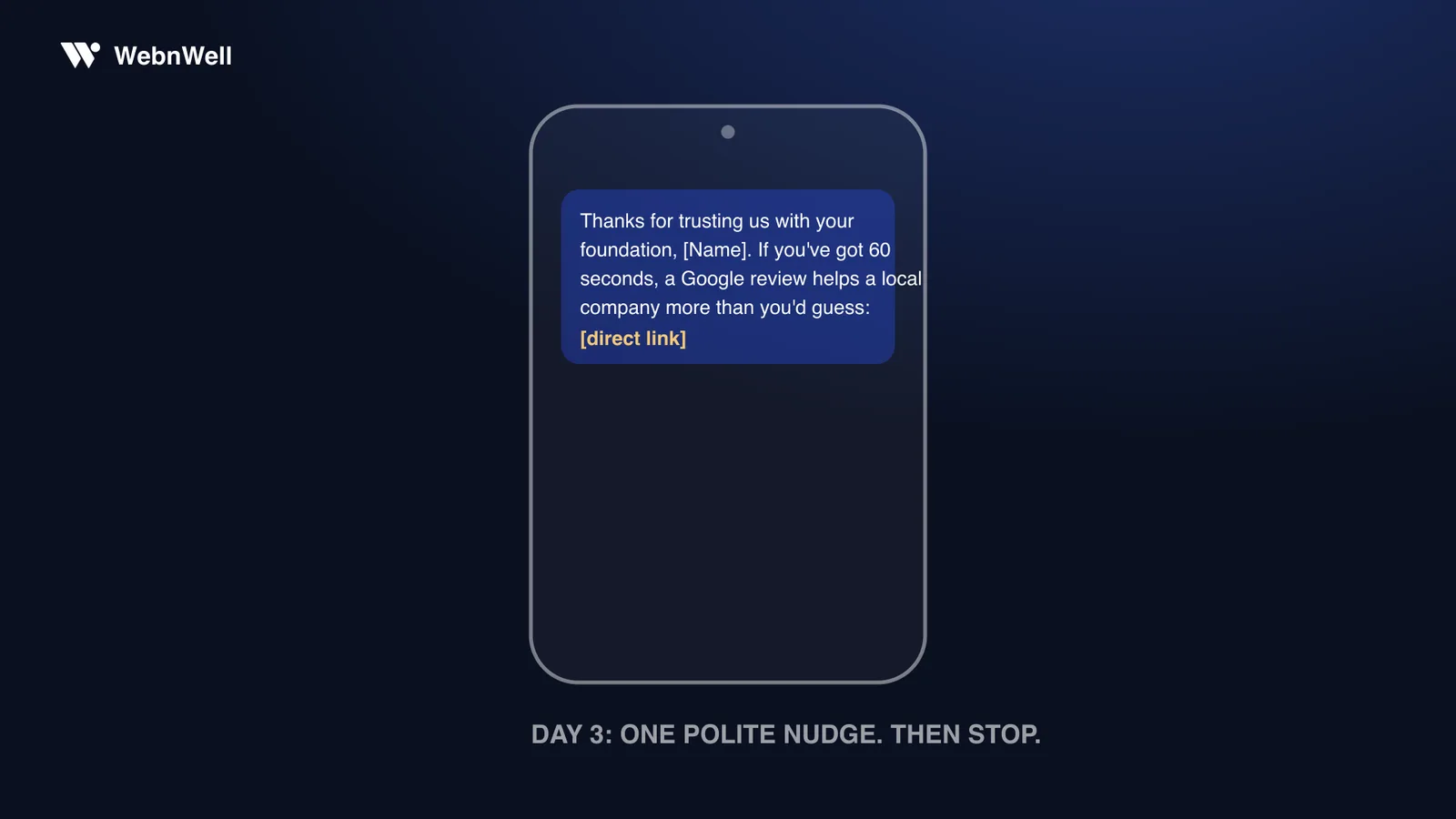
The point of automating this is that you never have to remember it again, the same reason we’re loud about automating the first five minutes after a lead calls. Follow-up that depends on an owner’s memory doesn’t happen. Follow-up that’s wired into the job does.
Three lines you shouldn’t cross
Worth saying plainly, because “get more reviews” attracts bad advice:
- Don’t buy reviews. Fake reviews can get a profile penalized or wiped, and homeowners can smell them anyway.
- Don’t gate. Gating means surveying customers first and only sending the review link to the happy ones. It’s explicitly against Google’s review policies.
- Don’t pay or discount for reviews. An honest ask at the truck outperforms every scheme, and it’s the only version with zero downside.
The whole system is two moves: ask in person while the relief is fresh, and let a text deliver the link before you’ve left the street. Everything shadier than that is risk you don’t need.
What about the bad review you’re dreading?
Somewhere in the back of your mind there’s a reason you haven’t pushed for reviews: the more you collect, the more likely one of them is ugly. You’ll get one eventually. Everyone who does enough jobs does.
Here’s the reframe that makes it survivable: that review wasn’t written for you, and your reply isn’t either. Your reply is for the next homeowner who scrolls past it during her own search. She isn’t judging whether the complaint was fair; she can’t know. She’s judging how you handle it.

The reply formula is short:
- Acknowledge it. No lawyer voice, no counter-attack.
- Say what you did. The return visit, the re-inspection, the refund — whatever’s true.
- Take it offline. “Call me directly and I’ll make it right,” with your name under it.
Calm, brief, human. An owner who answers criticism like a professional is a trust signal a franchise call center can’t fake. Their replies read like templates because they are templates.
Reply to the good reviews too. Two lines each. It proves a human runs the place, and it tells every future reviewer their words will be seen.
One more uncomfortable truth: a 4.8 with steady, replied-to reviews often reads as more real than a thin, silent 5.0. Perfection at low volume looks fragile. Volume with honest handling looks like a business.
Reviews decide more than reputation now
If persuasion isn’t enough motivation, here’s the mechanical reason to care: reviews feed your ad placement.
Google’s Local Services Ads, the green-badge strip that sits above everything else on the results page, take your reviews into account when deciding which companies show up there. Don’t take my word for the specifics: pull up Google’s current Local Services Ads documentation and read the ranking factors for yourself, because the details shift and the source beats any summary. So the review system you build does two jobs at once: it convinces the homeowners who see you, and it helps decide how many homeowners see you at all.
It also makes every paid click work harder. You can get the budget math exactly right and still lose the job at the final step, because the homeowner who clicked your ad checks your reviews before she calls. Ads buy the visit. Reviews decide whether the visit becomes a phone call.
Every fresh review does two jobs: it persuades the homeowner who found you, and, through Local Services Ads, it helps decide how many homeowners find you at all.
Start counting from this Friday
Three moves, all doable this week:
- Grab your direct review link. It’s in your Google Business Profile under “Ask for reviews.” Save it somewhere you can text from in five seconds.
- Say the truck script on your next completed job. Steal mine word for word if you want. The first ask feels awkward. The tenth is routine.
- Wire the follow-up text into your job-completion process: the automatic thank-you with the link, the single day-three nudge, the hard stop.
Do that on every job through one season and check your profile again. The gap with the franchise won’t be closed. It’ll be closing, and fresh beats big more often than you’d think.
See your review profile the way a homeowner does
If you want the outside view, I record a free market audit video for foundation and waterproofing contractors, and reviews are one of the first screens I pull up: your profile lined up against the three companies a homeowner sees next to you. You get the counts, the freshness, the replies (exactly what she compares), plus what I’d fix first and in what order.