

The Challenge
Dentistry is one of the most expensive corners of Google Ads, and the corporate chains know it. They blanket entire metro areas with spend, absorb the cost of wasted clicks, and count on independent practices being unable to keep up. For a local practice, matching that budget is impossible — and trying to is exactly how ad accounts quietly bleed out on clicks that never become patients.
Bluffdale Dental came to us with a harder, better question than "how do we get more traffic?" They wanted every advertising dollar tied to something the front desk could actually see: a booked appointment and the treatment revenue behind it. General, cosmetic, and surgical dentistry each carry different patient intent and different economics, so a single catch-all campaign — the default most agencies ship — was never going to be accountable enough. The job was to build a structure precise enough that an independent practice could beat the chains on the searches that mattered most to it.
The Strategy
- Three treatment-specific campaign tracks: General, cosmetic, and surgical dentistry, each with its own keywords, ads, budget, and landing page.
- Booking-first landing pages: Every page built around one action — booking an appointment — not browsing.
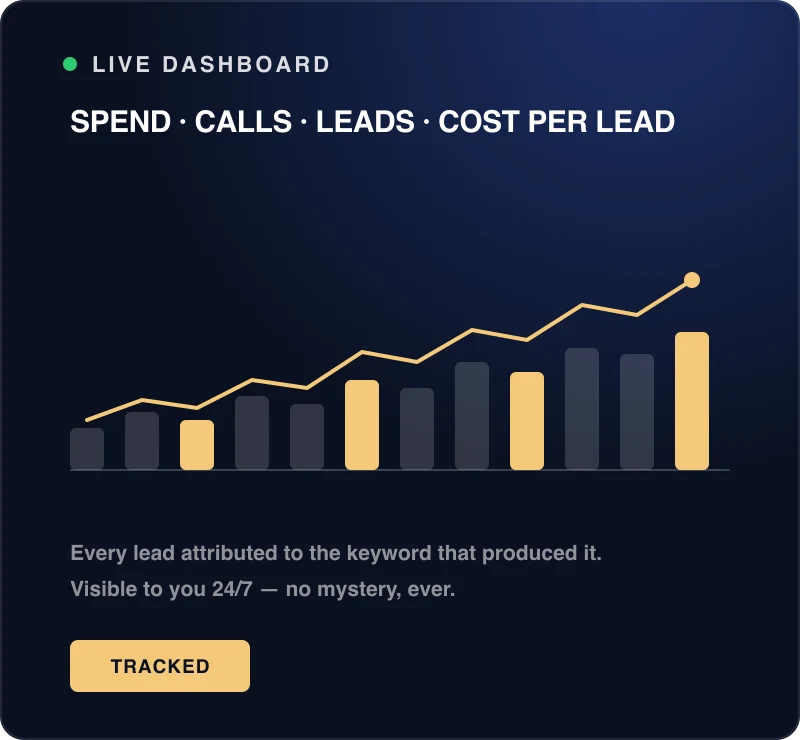
- Revenue tracking, not click counting: Call and form tracking tying every booked appointment to the exact keyword that produced it.
- Precision over budget: Dominate the specific treatments and local searches that matter instead of trying to out-spend the chains everywhere.
The Playbook
Local market research before launch
Because dental clicks cost real money, the research came first: which treatments local patients actually search for, what the corporate chains bid on, and — more importantly — the high-value searches they cover poorly. That map told us where an independent budget could win outright, so spend was never scattered across battles the practice could not afford to fight.
The treatment-line campaign split
We built three separate campaign tracks — general, cosmetic, and surgical — instead of one blended dental campaign. A patient searching for implants is making a considered, high-value decision; a whitening patient is far closer to an impulse purchase; an emergency toothache cannot wait until Monday. Separate tracks let each treatment line carry its own bids, budget, and message, so the economics of one never distorted the others.
Booking-first landing pages
Every track sent patients to a page with exactly one job: turn the visit into a booked appointment. Reassurance and proof sat at the top, treatment details were written in plain language instead of clinical jargon, and the booking action stayed within reach the whole way down — including a prominent phone option for patients who would rather call the practice than fill out a form. Pages that try to do everything convert nobody; pages built for one action convert.
Call and form tracking to revenue
Call tracking and form tracking connected every booked appointment back to the keyword and ad that produced it, and the practice's own records supplied the treatment value behind each booking. That closed the loop most dental marketing leaves open: not "the ads got clicks," but "this keyword produced this patient and this revenue." Once that loop closed, every budget conversation became a math conversation.
The budget reallocation loop
With revenue visible per keyword, optimization stopped being guesswork. We continuously moved budget toward the treatments and keywords booking patients at the lowest cost, paused whatever spent without booking, and kept A/B testing ads and pages against the reigning winners. Repeated relentlessly, that reallocation loop — not a bigger budget — is what compounded into more than $1.1 million in tracked sales.
Why It Worked
An independent practice cannot out-spend a corporate chain — and it does not have to. Chains spread budget across whole regions and every service line at once; Bluffdale Dental concentrated theirs on the specific treatments and local searches where the data said patients were bookable. Precision beat scale, and the three-track structure is what made that precision manageable.
The other half is accountability. Because every appointment was tracked to the keyword that produced it, budget followed evidence instead of instinct, week after week. That is the honest explanation behind the result: no single brilliant ad, just a structure that made wasted spend visible and a loop that kept removing it.